
AT WHAT COST
A REFLECTION ON INVESTIGATIVE DOCUMENTARY THE TRUE COST BY ANDREW MORGAN

Amid the post-pandemic boom in the fashion industry, I indulged in the infamous ‘haul’ on AliExpress. It came at a time when I had already been questioning my consumption choices: the cosmetics I use; the food I eat; the media I engage; what I buy... Long past stretching my money with the Black Friday and Singles Day sales and despite the lifestyle changes I am facing, I am still at the mercy of the gamified daily coins, games and tokens in case of an emergency haul; and there is always a new variation of an item that made it to my reviews to add onto my wish list. Gambling addiction warnings and the drunken bar-side meltdown trope are the bad press addiction to TikTok-age shopping sprees deserves. Winners know when to stop.
After the haul I uninstalled many e-commerce clothing apps that I could’ve shopped from my iPhone. They lost my money to finalists AliExpress, Woolworths and Superbalist. When the South African Post Office stalled deliveries of all the packages I bought past the occasion, I contingently wore a skirt that was bought at Truworths approximately 15 years ago, and will soon be eligible to be classified vintage. I was still awaiting my deliveries when I came across a (fast) fashion industry exposé.
The documentary brings one to consciousness about taboo fashion industry practices that are hidden in plain sight. Watching The True Cost feels like stepping into an apocalyptic world and should bring discomfort to anyone who loves a stylish outfit, and exorcize those consumed by greed. One with empathy watches and reflects whether recreationally hoarding heaps of clothing is worth it. Everyone who has ever bought a piece of clothing should watch it.
But empathy is not enough.
It is time to disrupt the fashion industry from within and beyond with urgent and synergistic reform. Too much goes into making a measly garment, and at our most consumerist level, we collectively have too much to lose. The cash cow will be milked dry and outlived by textile waste that will be painfully decorating landfills and oceans for centuries to come. At the time of completion of this article one South African Rand was equivalent to 5,82 Bangladeshi Taka, 43.36 Chilean Peso, and 0.054 USD.
The grim procession of fast fashion begins in undisclosed places and ends in Atacama, a desert in Chile. Some of the grim may get smuggled out to haunt the rest of Latin America. The bodies of waste are laid to bury themselves on bare land where they rest in pollution. It has been recently reported that the tons of waste are so large that they are visible from space using high resolution satellite imagery. This visibility is still expected to grow.
So again, who pays the price for your greed clothing?
Naturally, one might feel tremendous guilt after watching the documentary. Taking up activism against fast fashion is one of the most impractical things I commit to doing in my life. I am aware that I may huff and puff, but I most likely won’t blow the multi-trillion dollar business down. Observing the growth of wasteful consumption has brought me to no longer be passive in my relationship with clothes, but that is not the case for every other consumer it would take to radicalize fashion from the demand side.
There is much responsibility in deciding to beat the Gen-Z paradox and in finding balance between abstaining from unethical consumption and not falling into hyper-aware ethical consumption, with what feels like nothing in-between. I grew up using social media, but at timing critical enough to notice social media resultant consumerism change fashion culture. I used to look through magazines and yearn for the products I saw with no intention to buy them.
Browsing through the internet feels like looking through an unending magazine with looming impulse buys. I have been reverting back to reading printed magazines. There is more to this than nostalgia for the seasonal printed catalogues that stores would send once every couple of months back in the day. Mags are fulfilling. I read attentively and I feel a sense of completion after reading an article, unlike how I can spiral into browsing the internet for hours and still get the feeling that I am missing additional information. That being said, I obviously continued investigating after watching the documentary and I am always ready to know more. Ironically, this is the problem. Consumers are always chasing more and more is never enough.
I remember the times I would get excited over a magazine cover. I had no access to celebrities in real-time and I would commit time to get the dopamine rush of watching infomercials, unlike going about my day continuously seeing unwarranted ads. I do not recall seeing ads in the early years of Facebook or on Prince of Persia: Warrior Within age games by studio Gameloft. For a person who got fixated on Verimark as a child, I am doing a great job not buying everything I see on digital ads.
That's not all I'm nostalgic for
There is nothing my mother hasn’t dressed me in growing up and I often long for the variety of my childhood wardrobe. My father was never one to shy away from bold patterns, colors and prints, sometimes seeming to cosplay Nelson Mandela. Most of my childhood clothes were given away on my behalf. At a time when princess dresses just aren’t the same, I would prefer having personally handed them down as heirlooms. I have a few generational pieces in my closet and I still keep and wear a handful of unworn and torn clothes from many eras ago. I feel invincible when I style my vintage cardigan with brand new clothes. It looks nothing like the post-Tumblr bloggers’ interpretation of vintage aesthetics, which were the look of 1980s Sophiatown in my teens and are Victorian era looks in my twenties. The corset on sale now is severely run down and shapeless, in contrast to the clothes fashionistas thrifted or raided from their grandparents’ closets in my teens. Those were not more than six years ago. There is a rapid shift in fashion that rates quantity over quality. This shift accelerated between the Tumblr and Instagram ages. It has oversaturated the fashionista community, and it is especially disruptive on TikTok.
Growing up without much streetwear and under the lens of Bree Van Der Kamp builds character. I have wanted my own tailor for a while now, as my mother has hers. I am very particular with my sleeks, cuts and seams and there’s nothing I dread more than a pair of ill-fitting and tactlessly ironed pants. This is so poetically aligned to Danielle going vegan or Andrew living a principled life of dedication to homelessness.
My journey towards ethical consumption is paradoxically simple and daunting because I have always been sheltered into sustainable consumption. I have been decluttering my wardrobe. It is not an easy process because I do not only store what I wear, but for some subconscious reasons I take on archival like a couture house or like I am curating the Anna Wintour Costume Centre. Letting go of clothes feels like ripping off parts of myself and my memories. My mother wrapping me like a gift back in the day; taking me along to appointments with her seamstress, and teaching me how to care for fabrics recently reminded me of textiles that have since seemed to disappear off the face of the earth. And I realize that much has taken a knock from all the noise telling us what to wear.
There’s more to cottagecore than aesthetic cosplay
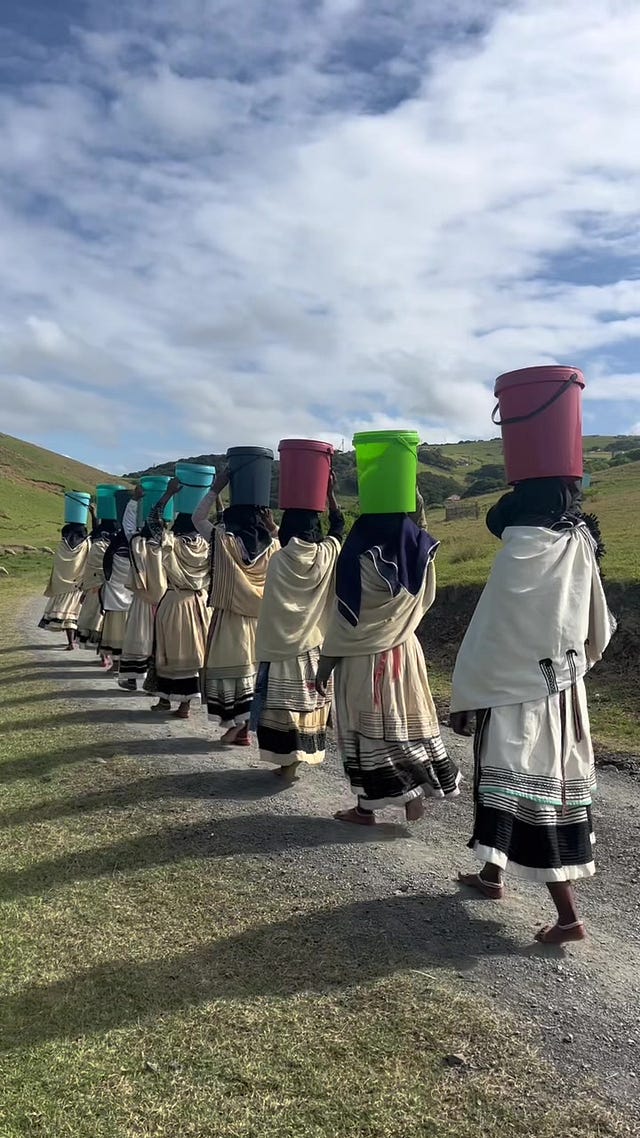
Firstly - global north, stop being so wasteful!!! I come from a community that does not throw clothes away. I was surprised to find out that there are masses of non-biodegradable polyester-based garments spoiling away at landfills and being discarded into oceans in the global north. In the Eastern Cape, South Africa, where I am from, it is standard practice for clothes to always have a purpose, whether they are passed down generations, up-cycled, donated, or recycled. ‘Repurposing’ is unspoken, but well-practiced as garments exhaust their value as “isikorobho” – a cloth used to wash cars, clean floors and remove household grease and grime, to paint concrete walkways, and for countless other uses that will be found. My late grandmother kept cash in many folds of random and benign pieces of old fabric sewn into her clothes to form deep pockets. Old items are worn for extra layering when it’s cold, or just because it is common practice for people to be clad in layered dress. I remember watching women dig into their bras to reach for their cellphones and money bags throughout my childhood. They inadvertently taught me that the functionality of a wallet does not mean that you need one, and so goes for many other possessions.
 Tiktok failed to load.
Enable 3rd party cookies or use another browser
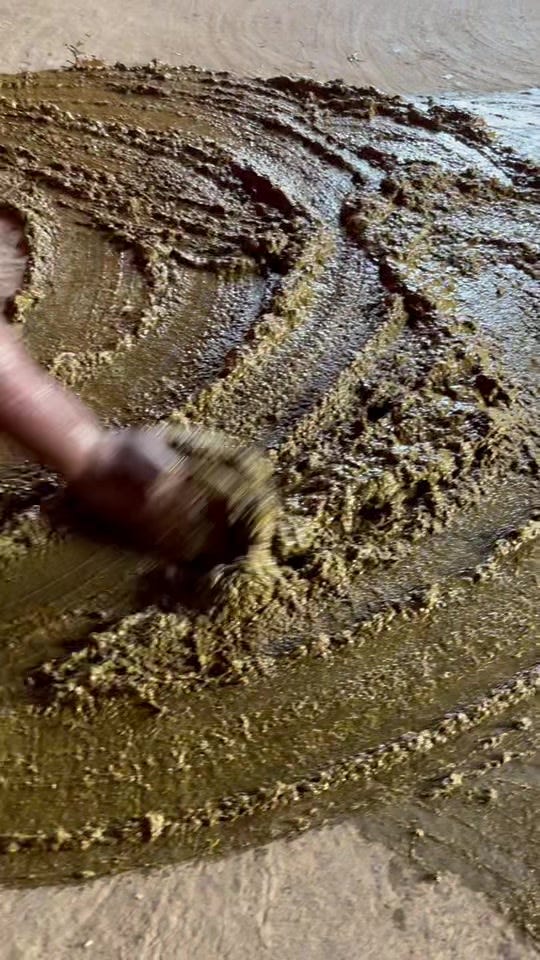
Growing up in the Eastern Cape, a breeding ground for ecofeminism, builds green fingers and character. People live on and work the land. Primal practices such as ”ukusinda” – polishing a hut floor with cow manure by hand, still exist, and the rolls of hills and valleys in the countryside provide crisp breathable air, coupling with oceans, horizons and simplicities that let you deeply connect with nature. The Wild Coast hosts tourists who would like to retreat into close knit community, raw adventure, traditional living and picturesque serenity in the world’s ungentrified state.
 Tiktok failed to load.
Enable 3rd party cookies or use another browser
The Eastern Cape has the largest spread of poverty in South Africa. Without diving too deep into the economics of it, the World Bank’s poverty calculator ranks South Africans exponentially poorer than people in the US, the UK and other higher income countries. Because the people of the Eastern Cape have always been instinctively environmentally conscious, they are often able to live self-sustaining lives with little to no income, and only an outfit or three. In Twitter and TikTok-speak people shop from Shein because they are poor. I am yet to witness poor people do that. I am also yet to see them widely adopt smartphones with Shein compatibility, or even know what Shein is.
The petroleum rush
From the documentary, the rush for fashion in Asia seems to model the rush for rich commodities like gold and diamonds in South Africa; and the displacement and exploitation of garment workers imitates that of migrant labour in the age of the Witwatersrand gold rush as industrialisation is typically concentrated in urban areas. Garment workers are massacred like the miners of Marikana on a random workday. Between colonial spatial planning and recent tremors it is difficult to imagine South Africa ever recovering from the consequences of mining. The same applies for the consequences of fashion in Asia and its unions are far more weakened. Concern is as thick as the pollution in the air about externalities like toxin-infused drying religious waters in Bangladesh and I find myself cheering for communities rejecting commercial activity. So long to the viral slums that would mutate around Xolobeni, the Wild Coast.
Dumping
The True Cost brought me to understanding why I have seen unpleasantly smelling heaps of clothing in Johannesburg. I never really figured out where the clothes came from until the documentary reconciled them with textbook definitions of dumping. True to South African culture, the dumped clothing is not thrown away. It is sold for sometimes a fraction of a single value of currency and its life cycle continues until it cannot be manipulated into living any further. Now more than ever, I am questioning what I truly re-imagine for an African economy, and whether South Africa builds a good case study for a potential textile and manufacturing industry renaissance. There is something happening in the East that is not receiving the scrutiny it deserves. Their manufacturing industries have been thriving all my life and it would take me time and error to list possessions of mine that are not made in China. One may argue, as I have, that Africa needs such a renaissance as the east. It has been unfortunate finding out that the Oriental grass might not be that green after all.
Retail and e-tail
The South African government’s Trade, Industry and Competition department recently started probing into disrupter Shein - one that has even disrupted individual tailors or designers and the markets for counterfeit and second hand goods. This is in response to fiscal problems such as a culture of tax avoidance in the Shein community, economic leakages, and in response to pressure from the South African retail sector. The Southern African Clothing and Textile Workers Union (SACTWU) protects its workers to an extent that may raise the guard of exploitative global business owners. It promotes their rights and holistic development and increases their wages in line with labour law even in the face of economic shrinkages and political pressures that continue to strain the industry. These largely include diminishing capacities at corporate levels and progressively aggressive consumer demand and lead times. The uphill climb to selling proudly South African is challenging the industry as South Africans and their sophisticated banking systems increasingly adopt e-commerce. The National Clothing Retail Federation has not yet publicly updated its perspective on the threat of eCommerce and of Shein in particular on fast fashion pulling the South African economy further onto its knees.
Shein reminds me of a good pyramid scheme. Between the panic buying at the bottom and organized crime at the top, I cannot say what will collapse Shein, but the fall will hurt. The recent culture of fashion and the internet is a diagnostic tool to me…and the European Union. Fashion forward countries such as France and Germany have pioneered taking long overdue legislative action towards business in fashion. It appears that the fashion industry might as well be a dark syndicate hidden in plain sight, but with reconfigured business models, innovation and design not all is doomed.
Clothes are important to us all, even nudists. Corporate is duty bound to make this a positive part of lives across the board.
I grew up when fast fashion buzz in South Africa was at most around local retailer Mr Price. The Mr Price churn is nowhere near as fast as Shein’s. It barely catches up to H&M and Zara. It has been insightful for me to find out that global retailers like Zara are fast fashion operations. They are too pricey for the average South African. Something about a higher price point brings an image of legitimacy. It’s like what used to be the gnashing of teeth at counterfeit designer. The fashion faux pas has been heavily destigmatized in the era of social media and fast fashion faking and making luxury fashion to be accessible to the average consumer. Not a good look.
We have come of age and my peers are hyping Foschini because of what they have convinced each other is improved design. It really is just outgrowing Mr Price. I am (im)patiently waiting for said peers to mature into shopping at Truworths for the sake of the economy and so they can finally stop questioning why citizens buy quality products from a local supplier.
The gaps in our industry are flying fashionistas out to buy in what are very much international black markets. From my experience custom duties do not offset the monies spent on global shopping sprees. Turning to e-commerce interventions is great for our wardrobes, but you can’t have your cake and eat it. Someone has to bear the brunt from your whopping shopping deals, and someone is in the global south. We must be sure that for what tax avoidance, translucent slap jobs, natural disasters and the all else are worth, importing items quite literally made off blood, sweat and tears really is enough of a good look and feel. We must be very sure.
South Africa cannot afford to adopt a culture of American fashion consumption. Excessive textile waste would destroy the fragile country. In recent years we have witnessed recurring natural disasters, most of which are the first I have seen in my life; and the imaginable disasters that would be aggravated by industrial activity at deadly lead times would set indigenous people back beyond the remnants of colonialism and Apartheid. Be warned by Rana Plaza workers in Bangladesh who have testimonies of the consequences of intentionally destructive business. In the documentary we heard the lamentations of indigenous people who face decaying rural communities with social, environmental, spiritual and other costs which remain unaccounted for in cost sheets, accounting books and corporate reports. I do not know what will happen to all the tie dye dresses everyone has worn out in the past couple of years or how much longer social media is going to warp extreme consumerism into existing as a South African phenomenon. Let us recall that as charming and decorated as it may be, clothing is a piece of cloth. Yes, some clothes make it to the MET and I love looking good too, but most are just loincloths. If the culture of fashion in the global north does not change vulnerable people’s homes will be wilting faster than 5$ dresses in a warm tumble dryer. I (YELL) call Ecofeminism to the front.
So back to my ‘haul’. Let's reflect on it
The Pinterest boards I drafted leading up to my haul felt unattainable prior to bringing my ideas to life with e-commerce. Shopping against fashion trends is much less stressful when you remember that the world has more than that within your sight and thanks to the internet, within your reach too. Granted, it is still a bit difficult when you live in a country from a continent that is not considered part of the world, that being Africa. Sometimes I think to myself, “For the sake of the commonwealth or something, please ship to South Africa.” Since watching the documentary I now think to myself, “For the sake of transforming the fashion industry, for the sake of protected labour and for the sake of a more inclusive global economy and reducing the unemployment crisis, please ship from South Africa!”.
I appreciate having the liberty to pick my wardrobe from anywhere in the world no matter how bizarre my wish list is. Perhaps retail in fashion should not be so prescriptive you cannot find a classical item you thought of buying haphazardly. Food retail cannot force fruits to be in season , but checkered socks being out of season is quite a senseless choice. I am still exhausted from window-shopping for a plaid outfit in 2022 and only finding generic tie dye two piece sets. We, the generation which grew up watching Bratz, are in an annoying era of fashion. We are the ones who dare to fit in. Like my peers, I have always wanted to look like a Bratz doll. Bratz dolls adorned my first watch, t-shirts and book covers for the majority of my childhood. Now, Bratz references dampen my passion for fashion. Perhaps I am a trendsetter in the heavily approaching wave of switching to Barbie?
I reconciled my haul items with ethical consumption principles and guidelines I took from the documentary and further research. Similarly to South Africa’s Takealot group, the AliExpress e-commerce market houses a pool of independent sellers selling diverse products. In tracking the supply chain of the products, I went as far as identifying the Chinese companies that own the stores I purchased from using information from their business licenses – which is very much on the surface level. The lines got blurrier as some of the different stores I purchased different products from were licensed to the same companies. While my tracking would not impress Jet Slootmaekers, I like to think of the little diversification I managed to achieve in my basket as a step forward from hypothetically handing all my money over to Shein. I can fairly charge it to more than a language barrier that the AliExpress-distributing companies lack transparency and that very early into tracking the footprints of their supply chains, I had reached a dead end.
Regarding product specifications, I must admit (with a pinch of salt) that I am proud of my little shopping spree. Out of a 21 package basket: eight clothing items, 10 accessories, three beauty products and a miscellaneous package; I could have bought one or two items in my basket at a local store. Otherwise, most of my basket was bought with purpose, tact and minimal influence from trends. I read the product specifications well post purchase and I am happy with the material distributions. Few clothing items are polyester based, and the rest of the fabrics are made from blended materials or cotton-based. I felt a high sense of accomplishment for not buying hoards of polyester after watching the documentary, but further research proved everything is not what it seems. Natural fibres are intricately produced and may pose higher environmental risks than synthetic fibres. Essentially, companies need to make less clothes and consumers need a better relationship with shopping, and to take better aftercare for their clothes. Consumers will always seek stimulation and it is more viable to regulate businesses who overexploit this need.
And back to the doccie
The documentary drew a contrast between ‘fashion’ as traditional seasonal collections to today’s fast fashion, an unsustainable culture and business that has 52 to 365 seasons per year. Fast fashion has a business model facilitated by consumerism, exploitation and other costs that far exceed the price of clothes. Clothes are not meant to be cheap from and I am now committed to strictly judging stores that churn out clothes that generate super high revenue at super low prices. I am also fully committed to judging people who just won’t get out of the hobby of hoarding cheap and low quality clothes. No! We do not endorse compensating labourers in proportion to their productivity instead of a fair wage, forcing them to do the work of two business days in one every day to get by!
Shein has disputed claims about having an unethical supply chain and worker exploitation and is difficult to probe due to non-disclosure about the company and its operations. After much scrutiny the company is currently offsetting its downfall by collaborating with small-scale designers from which they would otherwise steal. As it seems. The 14 year old cash grab has intrapreneurial initiatives such as SheinX, a recent rebranding endorsed by statesmen in Ireland, which rips off rising and independent designers with their consent.
I agreed with Safiya Minnie when she said fashion buyers have the responsibility to take production trips. Key players in supply chains override fool-proofing the quality of the production process, and the globalization ideal of creating more jobs and paying lower prices is a farce. Her organization rewards its female staff with trips to fashion markets such as London similarly to the value seen in villager artists and crafters who are drastically undervalued in South Africa, where their labour and crafts are disposable. Benjamin Powell said the degrading and violating working conditions of the women who make our clothes are not the worst thing that could happen to them and swore they were just trailblazing in what would change to be a good working environment in the future in the 2015 film. This is true looking back at the pressures industries have passed through to unionize, and ignoring all other factors. SACTWU was not built in a day.
However, no corporation should be left behind. Enough parts of the world have developed well enough to run ethical business models and shut out black markets. Globalization sounded much more progressive when I heard about it a decade ago. Yet, it came with many bags, but mostly baggage. Baggage we have weighed too heavily on its pros and not enough on the cons
Kate Ball-Young was also unbothered because of the supposed lack of danger in sewing; which is only part of the garment construction process and subject to inhumane lead times, chemical toxins in fabrics and other occupational hazards. According to Kate they could have faced actual danger doing hard labour in mining and and not benign tragedies like collapsing factories and poor quality of life. Kate must have been struggling to get a new Minesweeper high score during this time. I call Ecofeminism to the front again, and reject the undervaluing of women’s skills and labour.
I think of Shima Akhter sometimes. People like her go unsung. I do not think one can be well after working in a sweatshop since childhood, but I hope she is well. I love clothes, but that is progressively trumped by my love for style. Quietening noisy fads elevates my personal style and it has given me the green light to clear my closet and to buy less clothes. I commend Asian women for their design and crafting. I often think about a woman I crossed paths with at an oriental market. She tied my wrap into the most beautiful turban style I’ve ever worn. She might have been a renowned stylist had she been born in the west.
Things have been so much worse since the documentary and I hope a sequel is imminent. The future of fashion must change. We are building ethical brands, and we substituting unnecessarily filling closet space with letting trends pass, garment rentals, clothing swaps and more. Let us see more celebrities on the green carpet. From now on we are honouring green contracts and boycotting bad business. We are letting go of shopping to no end as a hobby and asking ourselves ‘I got a cute fit, but at what cost?’